
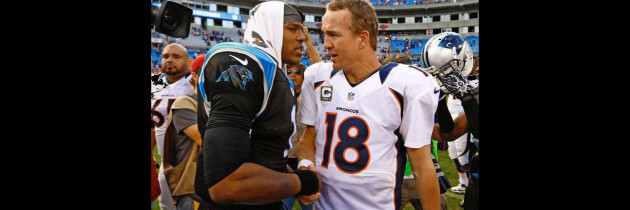
Two Quarterbacks, Two Paths, One Super Bowl
The two most important players in Super Bowl 50 got where they are through different means 11 months apart—Cam Newton to Carolina as the first pick of the 2011 draft and Peyton Manning to Denver in a frenzied 2012 free-agency period that began with Manning asking a coaching friend, “I don’t know what to do—what does a free agent do?”
The abridged tales of how one of the most intriguing quarterback matchups in Super Bowl history—the elder statesman in the twilight (Manning) versus the quarterback of the next generation (Newton)—was made possible in the past five years:
April 2011: Getting comfortable with Cam
The GM of the Panthers, Marty Hurney, had a rookie head coach, Ron Rivera, to go quarterback-shopping with early in 2011. This was going to be Hurney’s call, but Rivera had to be comfortable with it. The fact-finding on the off-field stuff was handled on scouting trips to Florida and Blinn College, a junior college in Texas, and Auburn. At Florida, a stolen laptop charge, and Newton’s entry in a diversionary program for it, was seen as college mischief. Three colleges in three football seasons was bothersome, but the Panthers saw it as Newton’s intense desire to play football, not sit the bench at Florida. But a real key for Hurney and Rivera were two independent trips to Newton’s home in Georgia. There, they met Newton’s mother, father, grandmother and two brothers, and got a strong feeling of family and a kid who was raised right.
The night before Newton’s Pro Day workout, Hurney and Rivera met with Newton and were impressed when he told them he fully intended to be a top NFL quarterback and knew how much work and how much study it would take, and they could trust him to be the kind of worker and practice player who could accomplish that. They knew he was raw—Newton had but 290 major-college throws on his résumé—and they had to get comfortable with knowing he was a work in progress. “Power arm,” praised the well-respected Greg Cosell of NFL Films, after studying the pre-draft Newton. But … “Limited QB skills. Accuracy a major concern. Poor mechanics.”
Hurney and Rivera knew there was work to do, but more and more felt the prospect was too good to pass up. They worked on Blaine Gabbert and Jake Locker and Christian Ponder, but didn’t get as far down the road with any as they did with Newton. There was a game in Newton’s Auburn season, 2010, that left an indelible mark on the Panther brass. Alabama was beating Auburn 24-7 at halftime in Tuscaloosa, and Newton told the coaches he wanted to speak at halftime. He spoke, passionately, to the team. Auburn outscored the Tide 21-3 in the second half (two Newton touchdown passes, one Newton touchdown run) and won 28-27.
Now about the Blinn College experience. Newton went through two mostly bench seasons at Florida (2007, 2008) and was facing the same—behind Tim Tebow—in 2009. Instead of transferring to a big school and sitting a season, Newton decided to go to junior college for a year, then transfer to a big school to play in 2010. Blinn was important not only for the football (Newton threw 22 touchdowns and five picks, with 16 rushing touchdowns, playing the Pistol) but for the way he acted off the field. I remember talking to then-Blinn coach Ronny Feldman that spring, and he was livid about the impression that Newton was a phony. “I heard somebody on the radio the other day talk about his fake smile and how he’s not genuine,” said Feldman. “He is full of s— with a capital ‘S.’ If I had a rock, I’d throw it and hit that guy right in the mouth. He doesn’t know Cam! I was with him day after day, side by side, for a year. I can’t say enough good things about him. He’s a yes-sir, no-sir kid, 100 percent trustworthy, with a strong passion to compete at anything. What a strong, strong leader. The first day here [in the off-season] they were all lifting, going after it hard. When it was over, they all thought it was done. But Cam, who doesn’t even know these guys yet, says, ‘I’m gonna be out there throwing if anyone wants to come.’ Five or six go out. The next day, 10 or 15 are out with him. Later in the week, I see him out there running the stadium stairs, and a couple days later, he’s got a bunch of guys out there with him. A natural leader. Charismatic.”
That’s the review Feldman gave the Panthers. When the draft was over, I was told that was an important piece to the puzzle. And the Panthers, on April 28, 2011, made Cam Newton the future of their franchise.
March 2012: Being patient with Manning
“People want to know the reason,” Manning said, searching for one, almost grimacing trying to explain himself. His strange free-agency search was over and he was standing off to the side of a stage in Denver after being introduced. “There really isn’t one. I could have pictured myself on any of those other teams. But what it came down to is, this just fit. It felt right.”
Manning was cut by the Colts, who were set to draft Andrew Luck as their quarterback of the future. And Manning had to explain to all about the condition of his neck, which had undergone four surgeries in the previous two years, causing him to miss the 2011 season. There were a slew of medical visits. One night, staying with his old college coach, David Cutcliffe, in Durham, N.C., there was knock at the door after 9 p.m. It was the San Francisco team doc, there to give Manning a thorough physical and to report to coach Jim Harbaugh whether Manning was a medical risk worth taking. Overall, Manning’s search took him from Miami to Indianapolis to Miami to Denver to Phoenix to Indianapolis to Raleigh to Nashville to Raleigh to Knoxville to Chattanooga to Denver, as he confabbed with Washington, and with the Dolphins, Cardinals, 49ers, Titans and Broncos. He turned down a visit from the Jets, the Chiefs, and from Seahawks coach Pete Carroll, who flew to Denver to see him during the process … and Manning wouldn’t take the visit.


